
Alongside the tenancy reforms that took effect on 1 May 2026, the Renters' Rights Act sets out two further changes that will reshape how the private rented sector operates: a national Private Rented Sector Database and a dedicated Landlord Ombudsman. Neither is fully in force yet, but both are coming, and landlords who prepare early will find the transition far less disruptive.
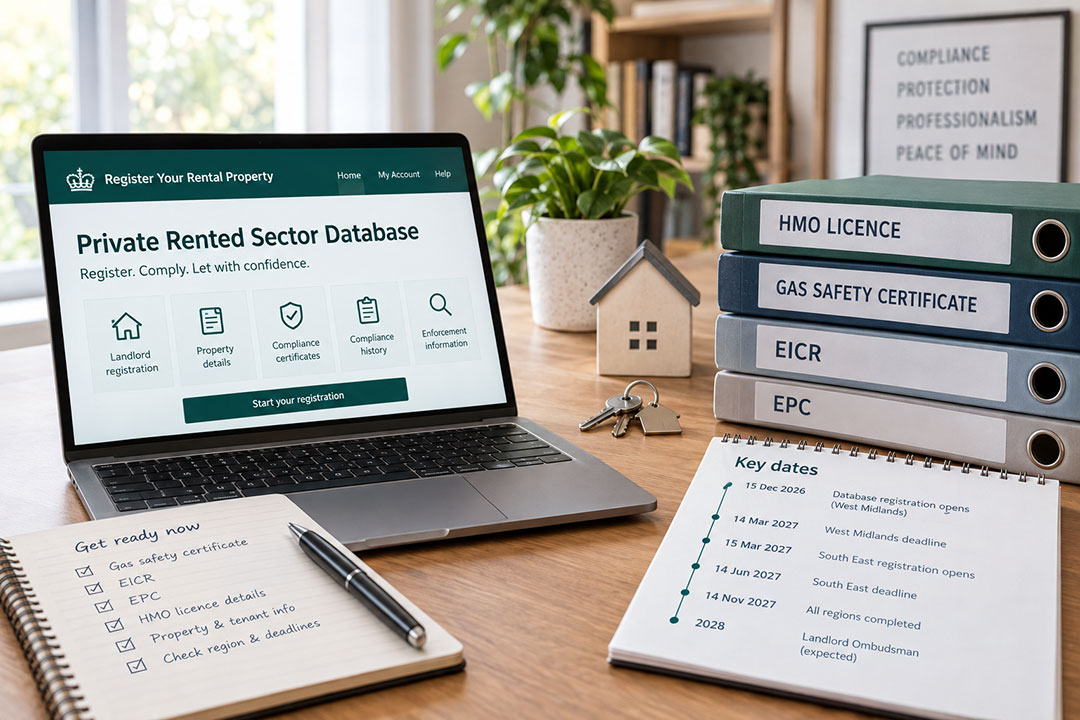
What the PRS Database is
The PRS Database, officially branded Register Your Rental Property, will require every private landlord in England to register themselves and each property they let. It will incorporate and expand on functions currently performed by the Database of Rogue Landlords and Property Agents, bringing landlord registration, compliance history and enforcement information together in one place.
Registration will require details such as the landlord's contact information, the property address and type, occupancy status, and confirmation of key compliance documents including a valid gas safety certificate, an in date EICR and an EPC of the required rating.
Why it matters for HMO landlords specifically
For HMO landlords, the database carries a particular weight. Registration is expected to be linked to a landlord's ability to rely on certain Section 8 possession grounds, meaning an unregistered landlord could find themselves unable to recover a property even where a valid ground otherwise exists.
Given that HMOs already sit within a separate licensing regime, landlords will effectively need to keep two registers current: the existing HMO licence and the new PRS Database entry. Consistency between the two, address details, occupancy numbers and compliance certificates all matching, is likely to matter.
The Landlord Ombudsman
The Act also introduces a mandatory PRS Landlord Ombudsman, expected to become operational after the database is established. The administrator has not yet been formally designated by the Secretary of State, so further details will follow as implementation progresses.
The Ombudsman will give tenants a free route to raise complaints about landlord conduct, with decisions that are legally binding. For landlords, this is intended to work both ways: it offers a faster and less costly route than court proceedings, and gives structure to disputes that might otherwise escalate. Membership is expected to be mandatory for every private landlord, including those who use a managing agent.
Timeline
On 9 September 2026 the government confirmed firm dates for the database. Registration opens on 15 December 2026, starting with the West Midlands, where landlords will have until 14 March 2027 to register. The service will then roll out region by region over the following months, with every region in England required to have completed registration by 14 November 2027. Registration will cost £65 per property per year, renewable annually.
For landlords with properties in the South East, registration opens on 15 March 2027, with a deadline of 14 June 2027.
The Landlord Ombudsman is expected to follow once the database is established, with mandatory membership anticipated from 2028. That date has not been legislated in the same way as the database timeline, so it should still be treated as an expectation rather than a confirmed deadline.
What landlords should do now
With firm registration dates now in place, the groundwork is worth starting immediately rather than waiting for a region's window to open.
- Keep gas safety certificates, EICRs and EPCs current and easy to locate for every property
- Make sure property details, such as bedroom count and occupancy status, are accurate and consistent across HMO licence records and any other registrations held
- Maintain a clear paper trail of tenancy agreements, notices served and communication with tenants
- Check which region each property falls into and note the relevant registration deadline
- Monitor announcements from the Ministry of Housing, Communities and Local Government and the NRLA as registration opens and further detail is published
The bigger picture
The PRS Database and Landlord Ombudsman are best understood as the next stage of a wider shift towards transparency and professionalisation in the private rented sector. Landlords who already maintain strong compliance records and clear tenancy documentation, whether managing directly or through a professional management company, will have far less to do when their region's registration window opens than those starting from scratch.